
 Custom Painting
Specialty Finishes
Glazes, metallics, limewash, and faux treatments — the finishes that give a room something paint alone cannot.

An old-world finish · Applied by hand
Venetian Plaster
Lime plaster, tinted, troweled in thin coats and burnished to a soft depth that no paint reproduces. Very few crews in Southern California still do this properly. We do.
Color that sits inside the wall, not on top of it.
Venetian plaster is a lime-based material that has been used on walls for centuries. It is tinted, applied in several very thin coats with a steel trowel, and then burnished — worked back over the surface under pressure until it tightens, cools and takes on a quiet sheen with real depth in it.
Because the pigment is suspended through the plaster rather than laid over it, the wall changes as the light moves across the room through the day. That movement is the whole point, and it is the one thing a painted finish cannot imitate no matter how good the paint is.
It also behaves differently over time. Lime plaster carbonates and hardens as it ages instead of building up stress like a film-forming coating, so it does not blister, peel or flake. On a sound substrate, properly applied, it is a finish you install once.
Where it works
- Entries, stairwells and formal living and dining rooms, where a wall is seen from a distance
- Fireplace surrounds and chimney breasts
- Master bathrooms, vanity walls and — with the right build — shower surrounds
- Feature and accent walls where a single surface has to carry the room
- Ceilings and barrel vaults, where the burnish catches the light
Four stages, none of them skippable.
Plaster records everything underneath it, which is why most of the labor on a plaster job happens before the plaster is mixed.
Substrate preparation
Plaster records every flaw underneath it, so the wall is skim-coated, sanded, and primed until it is dead flat before any plaster is mixed.
Color development
The plaster is tinted by hand and sampled on board in your own light. What reads warm at noon can read gray at dusk, so color is approved on site, not from a fan deck.
Multi-coat application
Several thin coats are troweled on in alternating directions. Each one has to cure before the next, which is why real Venetian plaster cannot be rushed.
Burnishing & sealing
The final coat is burnished by hand to bring up the sheen and the depth, then sealed. The surface shifts with the light through the day — no ordinary paint imitates it.
Walls we have installed.
Bronze, red, travertine-effect and light burnished finishes, in San Diego County and Palm Springs homes.
-
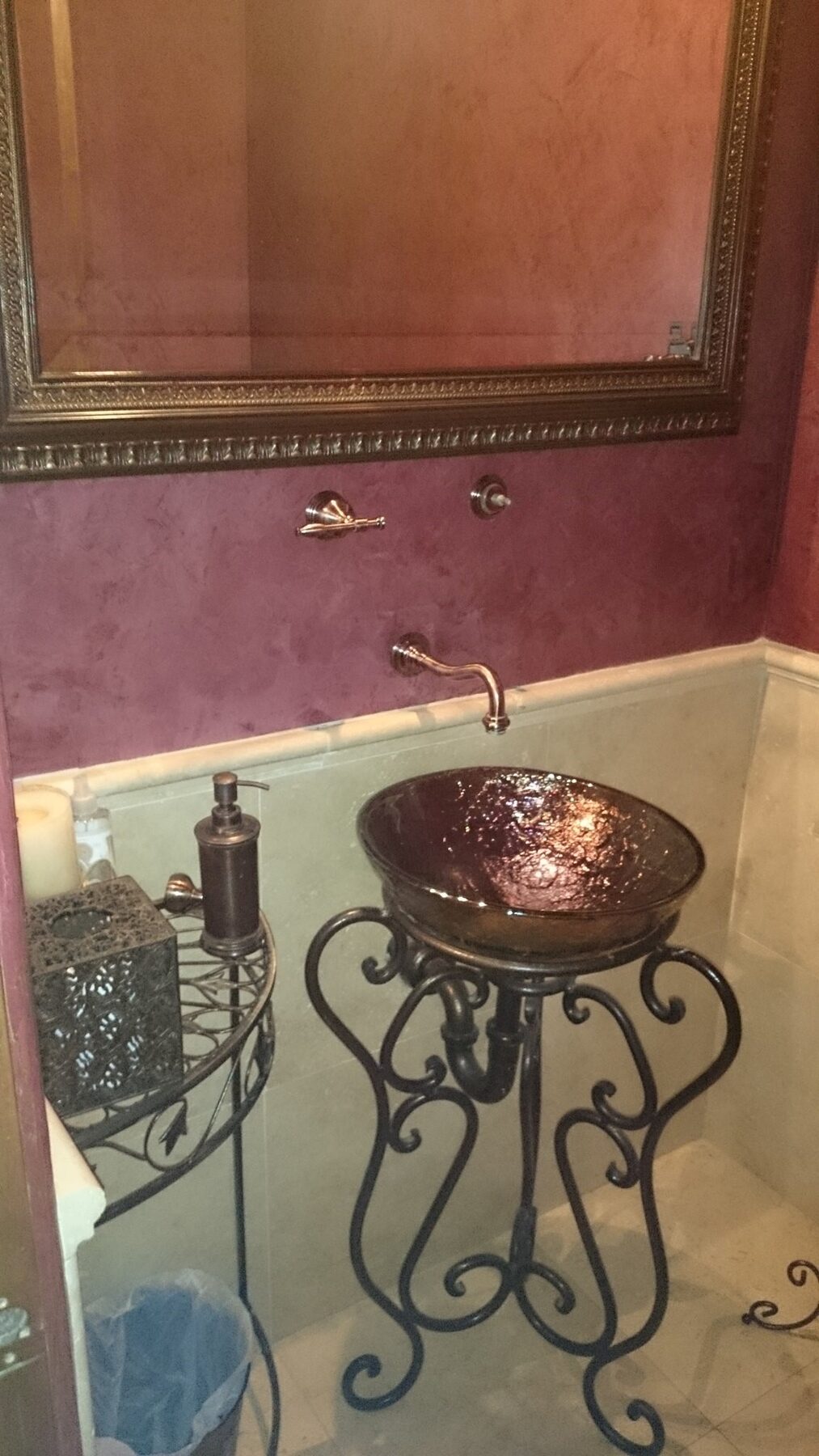
Burnished bronze Venetian plaster, formal dining room -
Deep red Venetian plaster feature wall -

Travertine-effect Venetian plaster -
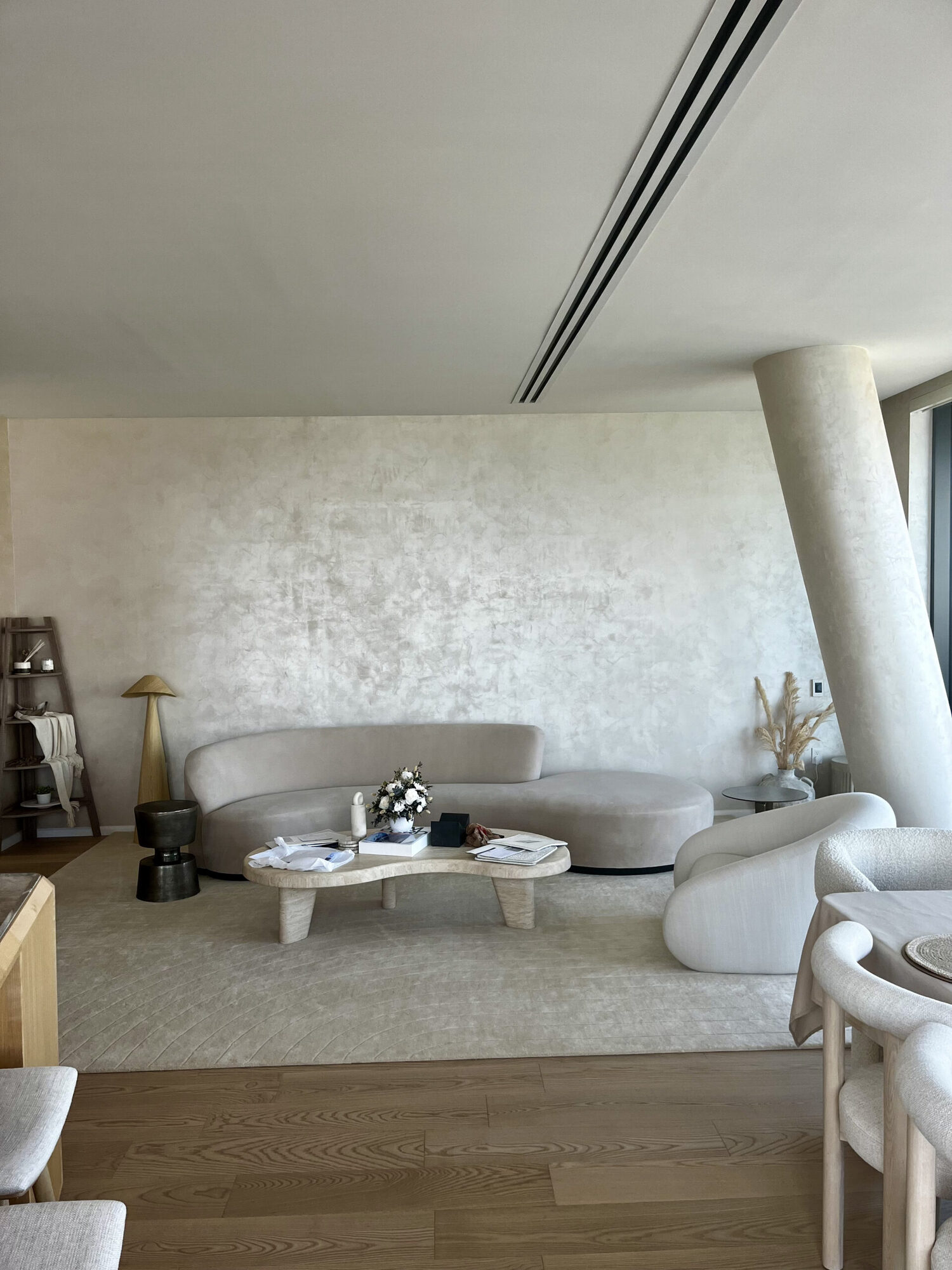
Light burnished plaster, living room -
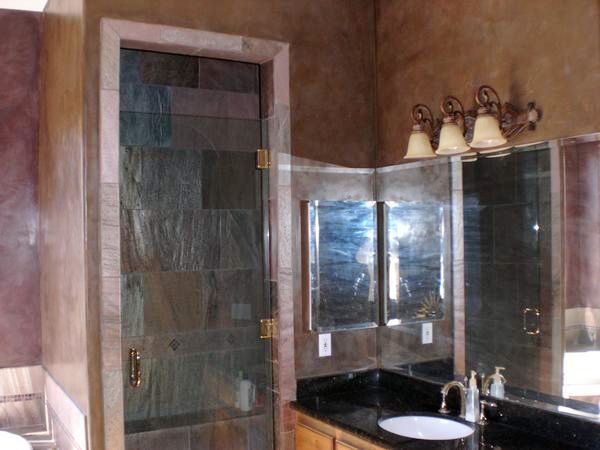
Slate and Venetian plaster, master bathroom -
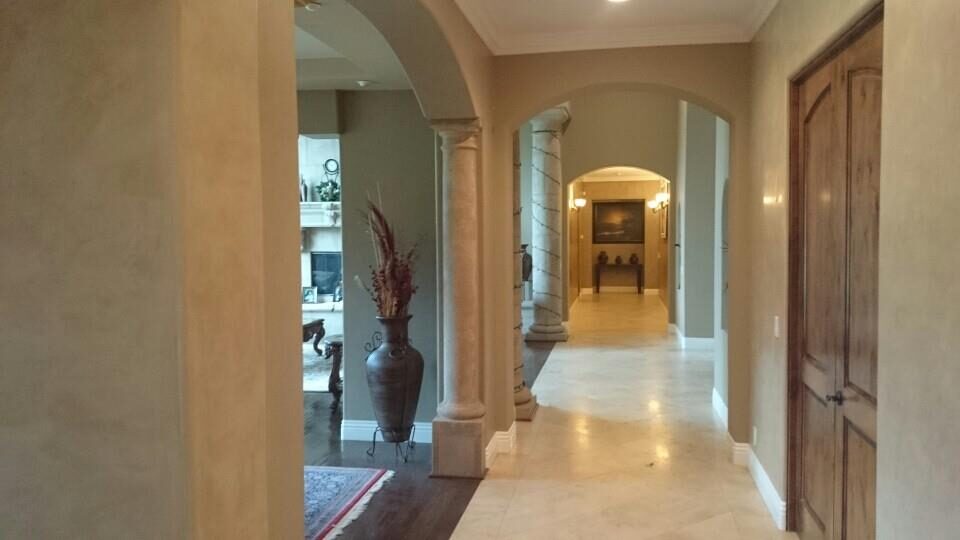
Travertine-effect plaster with stone surround
What homeowners ask about plaster.
What is Venetian plaster?
A lime-based plaster, tinted and applied in thin coats with a steel trowel, then burnished until it takes on depth and a soft sheen. It is a finish, not a paint — the color sits inside the material rather than on top of it.
How long does Venetian plaster last?
Applied properly over a sound substrate it lasts for decades. Lime plaster hardens over time rather than degrading, and it does not peel the way a coating can.
Can it be used in a bathroom or a shower surround?
Yes, with the right build and a suitable sealer. We have installed it in master bathrooms and on shower walls across San Diego County — lime plaster is naturally inhospitable to mold.
Can you match a color or a sample I have?
In most cases, yes. We prepare sample boards in the actual plaster and light them in your own room before committing, because the finish reads differently under different light.
Is it more expensive than paint?
Considerably — it is a hand-applied craft with several coats and a burnishing pass. It is priced per wall and per finish, and every estimate is written out before any work starts.
Related services
The rest of our finishing work
Plaster is usually part of a larger finishing scope. These are the services it most often sits alongside.
Custom Painting
Specialty Finishes
Glazes, metallics, limewash, and faux treatments — the finishes that give a room something paint alone cannot.
 Custom Painting
Interior & Exterior Painting
Painting is where this company started. An exterior job is eighty percent preparation — that is the part most contractors skip.
 Custom Painting
Cabinet Refinishing
Sound cabinet boxes do not need replacing. Stripped, repaired, sprayed, and they come back looking new for a fraction of the cost.
